Assessment Summaries Under the Procurement Act: What You Should Receive
What assessment summaries are under the Procurement Act 2023, what they must include, when you get them, and how they differ from the old standstill letter.
If you bid for UK public contracts under the Procurement Act 2023, the document you used to call a standstill letter has a new name and a tighter set of rules. It is now an assessment summary, and every supplier that submitted an assessed tender should get one before the contract award notice goes up.
For bid teams, that matters. Feedback is how you improve the next bid, and the Act is clearer than the old regime about what contracting authorities have to tell you.
What is an assessment summary?
Section 50 of the Act says that before a contracting authority publishes a contract award notice for a contract awarded after a competitive tendering procedure, it must provide an assessment summary to each supplier that submitted an assessed tender.
An assessed tender is one that was assessed when the contracting authorities decided the most advantageous tender (MAT), and was not disregarded. In a multi-stage competitive flexible procedure, that usually means the final stage, not every intermediate round.
GOV.UK's assessment summaries guidance puts the purpose simply: you should be able to understand why your tender was successful or unsuccessful, and unsuccessful suppliers should be able to see how the MAT was scored against the award criteria.
What has changed from standstill letters
Assessment summaries do a similar job to the old notices of a decision to award a contract, but the timing and content have shifted.
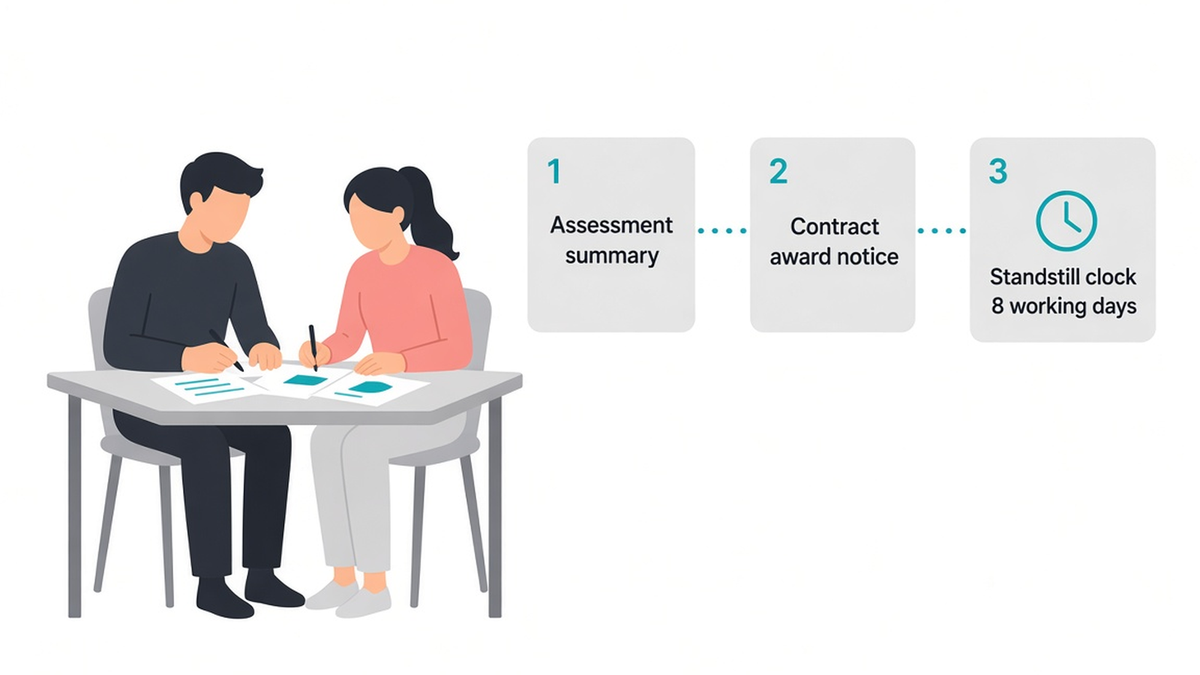
Under the previous rules, the standstill letter itself started the standstill period. Under the Act, the contract award notice starts it. The assessment summary has to land first, so you have the information in front of you for the whole standstill window.
Contracting authorities are not required to write a direct head-to-head comparison between your tender and the winner's. Unsuccessful suppliers do, however, receive the assessment information that was given to the successful supplier about how the MAT scored against each criterion (with commercial sensitivity redacted where the Act allows). Reading your scores next to the MAT scores is how you see the gap.
What must be included
The detail sits in regulation 31 of the Procurement Regulations 2024.
For the winning tender, the summary must include the supplier's name, postal and email addresses, unique identifier, a summary of the award criteria and assessment methodology (or a pointer to the full version), and how the tender scored against each criterion, including explanations that refer to relevant information in the tender. Sub-criteria and sub-totals have to be covered where they were used.
For every other assessed tender, you get the same information about your own tender (to the extent it was assessed), any further explanation of why you are not being awarded the contract, and the MAT scoring information described above.
A few practical points from the guidance:
- If a tender fails a pass/fail criterion and assessment stops there, the summary only has to cover the criteria that were actually assessed, plus the reason assessment stopped.
- Contracting authorities cannot simply restate the criterion and say the tender "demonstrated" or "failed to demonstrate" it. The explanation has to point to something in the tender.
- Extra feedback that helps you improve future bids is allowed, but not required. It is particularly useful for SMEs and new entrants, and worth asking for if it is missing.

Timing and the standstill period
All assessment summaries for a contract must be provided at the same time, and before the contract award notice is published. The guidance expects contracting authorities to issue them promptly after the award decision.
In most cases the contract award notice will go up on the same day. That notice starts the mandatory standstill period, which is a minimum of eight working days for most public contracts. The point of getting the summary first is that you can read it during that standstill, not after the clock has already started.
Assessment summaries do not have to be published on the Central Digital Platform. Contracting authorities can send them through their e-procurement system or by email.
Who gets one, and who does not
You should receive an assessment summary if you submitted an assessed tender in a competitive tendering procedure under section 19.
You should not expect one when:
- You were removed at an earlier stage of a competitive flexible procedure and never reached the final assessment (though contracting authorities should still tell you promptly, and guidance recommends similar feedback)
- A dynamic market is being established, or you are being admitted or refused admission to one (that is not the award of a public contract)
- A call-off contract is awarded under a framework (assessment summaries are not required for call-offs, though the guidance calls similar feedback best practice)
- Certain direct awards under sections 41 or 43
Assessment summaries are required when awarding a public contract under a dynamic market, because those awards run as competitive flexible procedures under section 19. They are also required when awarding a framework that is itself a public contract.
When a multi-supplier framework is awarded, unsuccessful suppliers only need the assessment information for the lowest scoring successful tender used as the relevant MAT, not for every winner.
How to use the feedback
Treat the summary as a working document for the next bid, not a letter to file.
Compare your scores with the MAT scores criterion by criterion. Where the gap is one or two marks, look at whether the explanation points to missing evidence, weak method statements or a criterion you underweighted in your own review. Where the gap is large, ask whether the opportunity was a poor fit before you rewrite the same answer for the next tender.
Check that every criterion you were assessed against has an explanation tied to your tender. If a score is bald, or the MAT information is so redacted that you cannot see why it scored higher, raise it during standstill while the contract has not yet been entered into.
Feed the lessons into your content library. If a case study scored poorly because it lacked quantified outcomes, fix the master version once. If a social value answer fell short against the model the buyer used, update the standard response rather than patching it bid by bid. Our tender evaluation criteria guide covers how MAT scoring is built, and our social value model article covers that strand specifically.
FAQs
Is an assessment summary the same as a standstill letter?
It replaces that function, but the standstill period now starts when the contract award notice is published, not when the summary is sent.
Do I get the winner's name?
Buyers should provide at least the name of the supplier that submitted the MAT where that does not create a significant burden. Identifying details beyond that are not required in summaries sent to unsuccessful suppliers.
What if I only reached an intermediate stage?
You are not owed a statutory assessment summary. Guidance still expects written notification and recommends using the same feedback structure.
Are assessment summaries published publicly?
No. They are provided to the relevant suppliers. The public-facing notice is the contract award notice.
Turn feedback into better next bids
The suppliers who improve fastest are the ones who can find the last good answer, the right evidence and the previous scores without digging through folders. BidScript keeps that material connected to the opportunity, so the lessons from an assessment summary land in the next draft rather than in someone's inbox.
The BidScript Team
The whole team!