Tender Evaluation Criteria Explained: MEAT, MAT & Scoring Matrices
Every mark an evaluator awards comes from the published criteria. How MAT, weightings and scoring matrices really work, and how to write answers that score.
Tender evaluation criteria decide who wins a public contract. Contracting authorities in the UK spend £385 billion a year, and competitive contracts are awarded against published criteria. Yet many bid teams only skim them before they start writing. That is a costly habit. Every mark an evaluator awards comes from the published criteria, the weightings attached to them and the scoring matrix that sits behind them.
If you have ever lost a bid you felt sure you had won, the answer is usually in the criteria. Either the response did not address what was being scored, or it spent too many words on the parts that carried the least weight.
This guide gives you tender evaluation criteria explained in plain terms: what they are, how MAT replaced MEAT under the Procurement Act 2023, how weighting and the quality vs price ratio work, how scoring matrices and moderation panels turn your answers into marks, and how to write responses that score.
What Are Tender Evaluation Criteria?
Tender evaluation criteria are the published rules a buyer uses to compare tenders and choose a winner. In UK public procurement they are called award criteria, and they must be set out before any tender is submitted.
Under section 23 of the Procurement Act 2023, award criteria must relate to the subject matter of the contract, be sufficiently clear, measurable and specific, and be a proportionate way of assessing tenders. Buyers cannot invent a new test halfway through and mark you against it.
That gives bid teams a real advantage. The buyer has told you, in writing, exactly how your response will be judged. Everything in the evaluation is traceable back to the tender documents.
Award criteria vs conditions of participation
It helps to separate two different gates. Conditions of participation decide whether you are allowed to compete at all, covering things like financial standing and technical ability. Our guide to conditions of participation explains how those work.
Award criteria come after that gate. They decide which of the suppliers who passed is the best choice for this contract. A strong response to the award criteria cannot rescue a bid that fails a condition of participation, so check both.
MEAT vs MAT: What Changed Under the Procurement Act 2023
For years, public contracts were awarded on the basis of MEAT. Since the Procurement Act 2023 came into force on 24 February 2025, new procurements use MAT instead. The two acronyms are often used interchangeably, but they are not quite the same thing.
MEAT under the old rules
MEAT stands for most economically advantageous tender. It was the award basis under the Public Contracts Regulations 2015. Buyers identified MEAT on the basis of price or cost, often through the best price-quality ratio, which let them weigh quality, technical merit and social factors alongside price.
MAT under the Procurement Act 2023
MAT stands for most advantageous tender. GOV.UK guidance defines it as the tender that both satisfies the contracting authority's requirements and is the best tender when assessed against the award criteria and the assessment methodology.
Dropping the word "economically" was deliberate. It signals that buyers can look beyond the lowest cost and give real weight to quality, social value and delivery. The same guidance notes that awarding on price alone is still possible, but is unlikely to be suitable for most contracts.
Which one applies to your tender?
Check the regime named in the tender documents. Procurements started under the 2015 rules continue under those rules, so for some time you will still see MEAT in older frameworks and long-running competitions. Anything advertised under the Procurement Act 2023 uses MAT. Our guide to the Procurement Act 2023 covers the wider changes.
How Weighting and the Quality vs Price Ratio Work
Where there is more than one award criterion, the buyer must set out the relative importance of each one. Most do this with percentage weightings, although the Act also allows criteria to be ranked in order of importance.
A typical split for a services contract might look like this:
- Quality: 60%
- Price: 30%
- Social value: 10%
That ratio tells you where the marks are. In this example, quality is worth twice as much as price. A team that spends weeks shaving its price and writes its method statement in an afternoon has its effort the wrong way round.
How price is scored
Price is often scored against the lowest bid. The cheapest tender gets full marks, and everyone else is scored in proportion to how far above it they are.
GOV.UK guidance on assessing competitive tenders warns buyers to be aware of the potential negative impact of these relative scoring mechanisms on value for money. Read the methodology closely to see how this buyer scores price, because it changes how much a small price cut is actually worth.
A common relative formula works like this: your price score equals the lowest price divided by your price, multiplied by the marks available. If price is worth 30 marks, the lowest bid is £90,000 and yours is £100,000, you score 27. Cutting your price by 5% to £95,000 adds only about one and a half marks, which a stronger quality answer can easily outweigh.
Social value
For central government buyers, social value now has a floor. PPN 002 requires a minimum 10% weighting of the total score for social value in procurements under the Procurement Act 2023 that began on or after 1 October 2025.
At 10%, social value is often the difference between first and second place. Treat it as a scored question in its own right, with specific, measurable commitments, not a paragraph of good intentions.
Scoring Matrices: How Evaluators Mark Your Answers
The assessment methodology must explain how tenders will be assessed against the award criteria, including any scoring matrix the evaluators will use. That matrix is the most useful page in the tender pack.
Scales vary from buyer to buyer. A common example is a 0 to 5 scale:
- 5, Excellent: fully addresses every requirement, with detailed, relevant evidence and added value
- 4, Good: addresses all requirements with good supporting evidence
- 3, Acceptable: meets the requirements, with some gaps in detail or evidence
- 2, Limited: partially meets the requirements, with significant gaps
- 1, Poor: barely addresses the requirements
- 0, Unacceptable: no response, or one that does not address the question
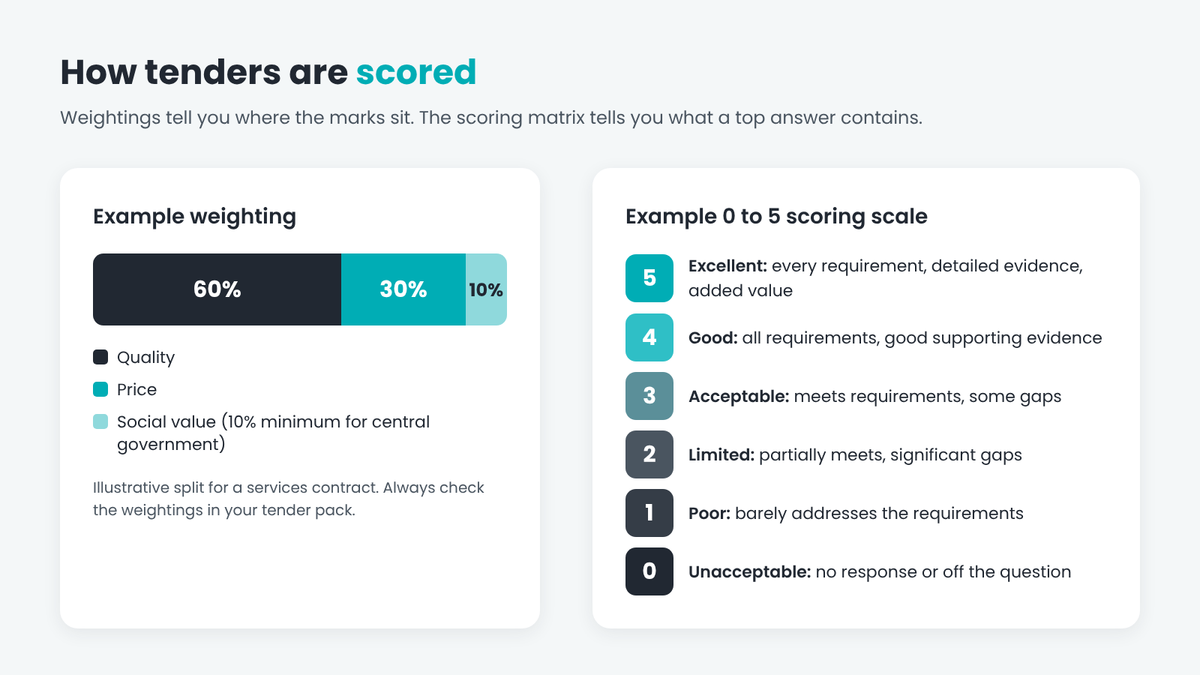
Look at the gap between a 3 and a 5. It is almost always about evidence and specificity. Saying you will do something earns an acceptable score. Showing how, with named people, real data and past results, earns the top marks.
How moderation panels reach a final score

On larger tenders, several evaluators usually score each answer on their own first. A moderation panel then meets to compare scores, discuss differences and agree a final mark for each question.
This matters for how you write. Every evaluator needs to find the same evidence quickly, so a clear structure that follows the question works in your favour. If one evaluator has to hunt for your answer, the panel may never find it.
Pass/fail tests and minimum quality thresholds
Some criteria are pass/fail. GOV.UK guidance says that if failing one or more criteria would disqualify a tender, the assessment methodology must say so. Buyers can also set a minimum score on key quality questions, below which the whole tender is rejected.
Find these tests before you start writing. A brilliant response that scores a 1 on a question with a minimum threshold of 2 can be out of the competition, whatever the rest of it scores.
If your team reads the scoring matrix only after the first draft is finished, you are editing in the wrong direction. BidBot, BidScript's AI bid teammate, includes an Evaluator Mode that stress-tests your answers before the evaluator scores them, so weak spots show up while there is still time to fix them. Early customers have seen win rates improve by up to 50%.
How to Write Responses That Meet the Tender Evaluation Criteria
Knowing how marks are awarded is only useful if it changes how you write. Time is usually short: under section 54 of the Procurement Act 2023, the minimum tendering period for an electronic tender with all documents available from the start is 25 days, and the clock starts when the notice is published. These steps turn the criteria into a working plan.
- Map every criterion before you write. Build a compliance matrix listing each question, its weighting, its word limit and any pass/fail test or minimum score.
- Spend time where the marks are. Allocate writing and review effort in proportion to the weightings, not the order of the questions.
- Mirror the question's structure. Use the buyer's own headings and sub-points so evaluators can tick off each requirement as they read.
- Write to the top band of the matrix. Read the description of a top score and make sure your answer contains everything it asks for.
- Prove every claim. Case studies, named roles, measurable outcomes and data move an answer from acceptable to excellent.
- Make social value specific. Commit to numbers, timescales and reporting, and tie them to the buyer's own priorities.
- Score your own draft. Before submission, have a reviewer mark each answer against the matrix exactly as an evaluator would.
Our guide on how to write a winning tender goes deeper on structuring each response.
Use your assessment summary
Under the Procurement Act 2023, every supplier who submitted an assessed tender receives an assessment summary. Under the Procurement Regulations 2024, it must include your score for each award criterion with an explanation, your total score, and, if you lost, information about the winning tender's scores for comparison.
That is free, detailed feedback on exactly how the tender evaluation criteria were applied to your bid. Where a standstill period applies, the award notice is followed by a pause of at least 8 working days before the contract is signed, so read your summary as soon as it arrives. Feed it into your content library and your next response. Over time, it also sharpens your bid/no-bid decisions, because you learn which buyers and criteria suit your strengths.
Tender Evaluation Criteria: FAQs
What are tender evaluation criteria?
Tender evaluation criteria, called award criteria in UK public procurement, are the published rules a buyer uses to compare tenders and choose the winner. They usually cover quality, price and social value, each with a weighting. Under the Procurement Act 2023 they must relate to the subject matter of the contract and be clear, measurable and specific.
What is the difference between MEAT and MAT?
MEAT, the most economically advantageous tender, was the award basis under the Public Contracts Regulations 2015. MAT, the most advantageous tender, replaced it under the Procurement Act 2023 from 24 February 2025. Both allow buyers to weigh quality against price. Dropping "economically" signals a stronger focus on quality, social value and overall value rather than cost alone.
What is a scoring matrix in a tender?
A scoring matrix is the scale evaluators use to mark each answer, often from 0 to 5 or 0 to 10. Each score has a description, such as "fully addresses all requirements with detailed evidence" for the top mark. Reading the matrix before you write shows exactly what a top-scoring answer needs to contain.
What is the usual quality vs price ratio?
There is no fixed ratio. It depends on the contract and the buyer. Many service contracts weight quality more heavily than price, for example 60% quality and 40% price, while simpler goods contracts may lean towards price. Central government buyers must also give social value a minimum 10% weighting under PPN 002.
What happens at a moderation panel?
At a moderation panel, evaluators who scored the same tenders separately meet to compare marks, discuss any differences and agree a final score for each question. It keeps scoring consistent and defensible. For bidders, it means every evaluator should be able to find the same evidence quickly in your response.
Final Thoughts
Tender evaluation criteria are not small print. They are the buyer telling you, in advance, how to win. Read the weightings to see where the marks sit, read the scoring matrix to see what a top answer contains, and check every pass/fail test and minimum threshold before you write a word.
MAT gives quality and social value more room than ever, which rewards teams that bring specific evidence rather than generic promises. Use your assessment summaries to learn from every result, win or lose.
BidScript is an AI-native bid management platform built for in-house work-winning teams, helping UK service businesses and contractors find, manage, write and win more public sector contracts, and it is rated 4.8 on G2. Book a demo to see how it helps your team write to the criteria on every bid.
The BidScript Team
The whole team!
Read Next
How to Write a Winning Tender: Step-by-Step Guide
Most tenders lose on process, not writing talent. A step-by-step guide to win themes, evidence-based answers and executive summaries that score.

What Is a Condition of Participation (CoP)? UK Procurement Act 2023 Guide
Ever seen a contract notice that feels like a quiz before you even write your bid? That's what they call a Condition of Participation (CoP)—and it matters, because if you don't tick those boxes, you don't even get to play.

The Bid/No-Bid Decision Framework: How to Qualify Opportunities
A practical bid/no-bid decision framework for UK public sector suppliers: matrix criteria, go/no-go gates and worked examples. Book a BidScript demo.