Winning the Quality Quest: A Bid Team's Guide to the PPN 026 Social Value Model
PPN 026 changes the rules of social value. From January 2027, winning public contracts is no longer about making bigger promises - it’s about proving you can deliver.
Introduction: The New Era of UK Social Value
In October 2026, the UK Commercial Function issued landmark practitioner guidance for Procurement Policy Note 026 (PPN 026): The Social Value Model. Officially replacing PPN 002, PPN 026 becomes mandatory on January 1, 2027, for all central government departments, executive agencies, and non-departmental public bodies undertaking covered procurements worth £1 million or more (inclusive of VAT). Under this refreshed framework, social value is defined as:
> "taking account of how a supplier will work for our communities to provide good British jobs, skills and opportunities in every postcode."
Far from being an isolated commercial update, PPN 026 is explicitly linked to the broader macroeconomic priorities set out in Budget 2026. As Chancellor John Healey emphasised, suppliers competing for government contracts "will be judged on their commitment to creating high-quality jobs, tackling local skills shortages, and supporting young people into work." PPN 026 operates as the procurement lever for a multi-billion-pound national workforce push, interfacing directly with national initiatives such as the £3,000 Youth Jobs Grant, the £2,000 apprenticeship hiring payment for small employers, £100 million in local apprenticeship services, a Jobs Guarantee for 18-to-24-year-olds on Universal Credit, a mandatory 3% apprenticeship requirement on major infrastructure projects, and the upcoming Milburn Review recommendations on youth employment.
For bid directors, proposal leads, and commercial strategists, PPN 026 marks the end of an era. The practice of winning tenders through inflated promise volumes—promising hundreds of uncosted school visits or unsustainable apprenticeship numbers—has been systematically dismantled. PPN 026 transforms social value evaluation into a rigorous quality assessment, where scoring is dictated by execution credibility, robust delivery plans, and targeted participant support.
2. Contract Thresholds, Weightings, and Scope
PPN 026 establishes strict statutory threshold rules and mandatory minimum score weightings based on total contract value (inclusive of VAT), governed by the Procurement Act 2023 (PA23). Bidders must understand these mandatory tiers, as social value weightings apply directly to evaluation scoring structures across central government.
Below £1m (above public contract threshold) - 0%
Must clear the relevant public contract threshold under PA23. Mandatory PPN 026 weighting does not apply, though Public Services (Social Value) Act 2012 duties still require buyers to consider economic, social, and environmental wellbeing.
£1m to under £5m - 10%
Mandatory minimum 10% weighting applied to the total tender score (or non-price quality criteria in absolute scoring models).
£5m and above - 20%
Mandatory minimum 20% weighting. Requires at least one published Social Value KPI on the Central Digital Platform and annual Contract Performance Notices.
When contracting authorities utilize absolute evaluation methodologies—such as Price per Quality Point (PQP) or Value for Money (VfM) indices—the 10% or 20% minimum weighting must be applied directly to the non-price (quality) criteria.
Scope Exceptions and Framework Transition Rules
To determine whether PPN 026 applies, commercial teams must evaluate several critical boundary rules:
- Dual-Threshold Rule for Works Contracts: A procurement falls under PPN 026 only if it clears both the statutory public contract threshold under PA23 and the £1m monetary floor. Because the public contract threshold for construction and civil engineering works sits significantly above £1m, a £4m works contract falls below its applicable public contract threshold and is therefore excluded from mandatory PPN 026 weightings.
- Excluded Procurements: PPN 026 explicitly does not apply to utilities contracts awarded by private utilities or to contracts where the primary purpose is overseas delivery (such as diplomatic posts or overseas embassies). Contract modifications executed after award that alter contract value do not retroactively trigger PPN 026.
- Framework Call-off Lifecycle Dates: Call-off contracts follow the PPN regime active when their parent framework was originally procured:
- Frameworks awarded between 1 January 2021 and 23 February 2025 retain PPN 06/20.
- Frameworks awarded between 24 February 2025 and 31 December 2026 retain PPN 002.
- Frameworks set up under PPN 026 (commenced on or after 1 January 2027) must evaluate social value at both the framework level and call-off level to satisfy Section 46(8) of PA23, enabling buyers to apply up to a 20% weighting on call-offs valued at £5m+.
> STRATEGY CONSULTANT NOTE: SECTION 90 PA23 TREATY-STATE ADAPTATION Under Section 90 of the Procurement Act 2023, contracting authorities are legally prohibited from discriminating against treaty-state suppliers. If preliminary market engagement indicates that international or treaty-state suppliers are likely to bid—or if the contract is capable of overseas delivery—authorities must adapt or waive PPN 026 criteria if those criteria would create unlawful obstacles, local preference barriers, or disproportionate compliance costs for non-UK bidders. Authorities cannot mandate local UK subcontractors or grant preference to bids utilizing UK supply chains. Bid teams representing international entities should actively invoke Section 90 during preliminary market engagement.
3. The Core Paradigm Shift: Scored on the Plan, Not the Size of the Promise
The fundamental evolution under PPN 026 is that social value evaluation is strictly qualitative. Panel evaluators score the quality, detail, feasibility, and credibility of a bidder's method statement and implementation plan—not the raw volume or scale of commitments offered. While promised quantities are written into the final contract as binding commitments and actively monitored post-award, high commitment numbers do not yield higher marks at evaluation.
The £5m+ Quantitative Volume Scoring Exception
On major contracts valued at £5m or more (inclusive of VAT), contracting authorities possess discretionary permission to score quantitative volumes under Model Award Criteria (MAC) 1a (e.g., job creation counts for NEETs, general contract jobs, high-growth sector roles, or apprenticeship counts). However, authorities can invoke volume scoring only on a case-by-case basis where preliminary market engagement proves that doing so will not create a barrier to entry for SMEs, VCSEs, or treaty-state suppliers.
Annex C Model Score-Allocation Method
Evaluators assess tenders against a standardized 0-to-10 scoring framework based on the authority's level of delivery confidence:
- Score 0 (No Confidence): The tenderer fails to provide a response, OR the response provides no confidence because more than one award criterion, sub-criterion, or additional criterion has been omitted, the response is of very poor quality and detail, or it is incomprehensible and irrelevant.
- Score 1 (Limited Confidence): The response provides limited confidence because one criterion or sub-criterion is omitted, the method statement lacks specific, measurable, and time-bound commitments, or the response lacks detail, clarity, or relevance, leaving a significant number of concerns requiring post-award resolution.
- Score 3 (Acceptable Confidence): All criteria and sub-criteria are addressed to some degree, providing an acceptable level of quality, detail, and relevance, though a small number of areas would benefit from greater clarity.
- Score 6 (Good Confidence): Demonstrates a good level of quality, detail, clarity, and relevance with no concerns, leaving no doubt of delivery capability. This score is achieved either by fully addressing all criteria independently with an exemplary method statement OR by supporting one or more listed Community Programmes (evidenced by a signed, dated commitment letter) while fulfilling all implementation criteria.
- Score 10 (Excellent Confidence): Achieved when the response meets all requirements for a Score 6 (via either a Community Programme or custom route) AND offers additional, relevant social value that aligns directly with the selected criteria published in the tender documents (applicable where sector market research confirms mature social value practice).
4. Navigating the Social Value Model Question: Two Bidding Routes
PPN 026 restores a standardised Model Question structure across all central government procurements. Bidders are required to set out specific, measurable, and time-bound commitments within strictly enforced word or page limits. Tenders must follow one of two distinct routes:
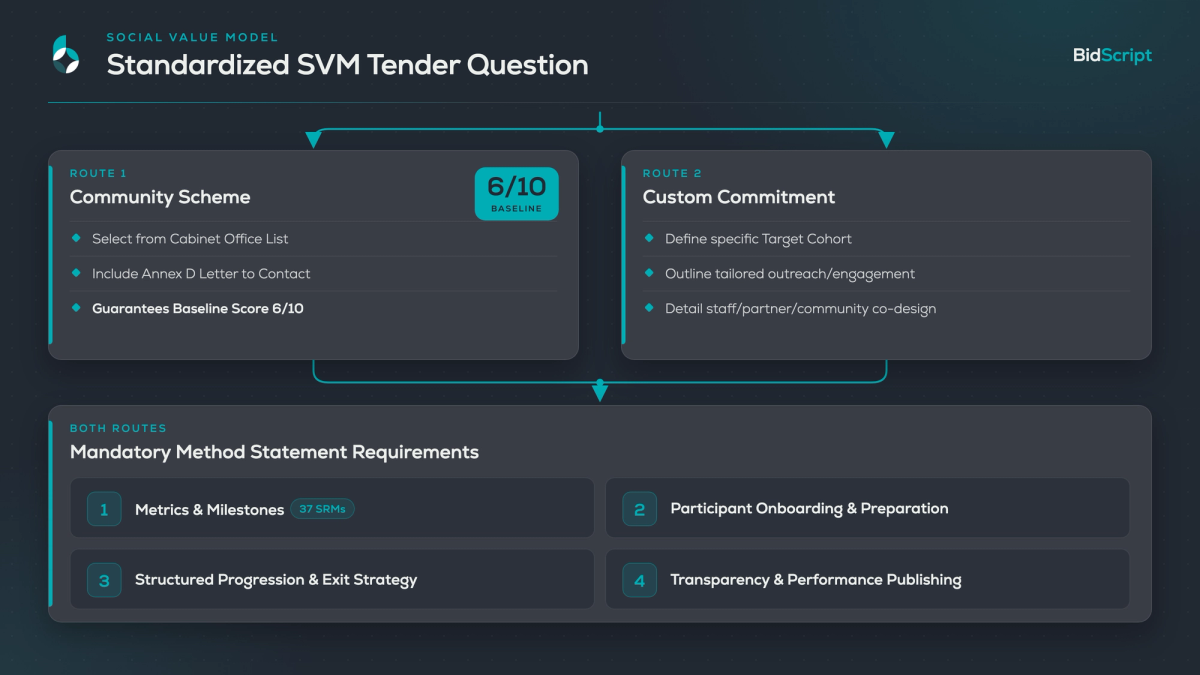
Route 1: The Community Programmes Route
Bidders can choose to support established initiatives listed in the government's official List of Community Programmes. To utilize this route, the bidder must submit a dated commitment letter addressed to the programme contact (using the template in Annex D), confirming the specific units or individuals supported and establishing that the support is additional to existing activities. Upon contract award, this letter is incorporated directly into the contract as a binding obligation. Under the Annex C scoring method, supporting a Community Programme while fulfilling all implementation criteria guarantees a baseline score of 6 out of 10.
> CRITICAL OPERATIONAL CONSTRAINT: STATUS OF THE COMMUNITY PROGRAMMES LIST Bid teams must note that as of late 2026, the Cabinet Office's official List of Community Programmes has not yet been published. While Route 1 is formally established in policy, the list remains forthcoming. Bidders preparing responses for early 2027 procurements must prepare robust Route 2 custom strategies as a contingency until the official list is active and populated.
Route 2: The Custom Commitment Route
If a bidder does not select a Community Programme, they must deliver a custom proposal that explicitly details:
- How the commitment fulfills the selected Model Award Criteria and sub-criteria.
- A defined target cohort (or a clear methodology for identifying and selecting one locally).
- Engagement mechanisms to reach, co-design, and tailor the offer specifically to that target cohort.
- A strategy for engaging staff, supply chain partners, customers, and local anchor institutions (e.g., volunteering, mentoring, education, or joint delivery).
Method Statement Prompts: The Four Mandatory Implementation Criteria
Regardless of whether Route 1 or Route 2 is selected, all responses must include a comprehensive implementation plan addressing four mandatory criteria. Successful bid teams build high-scoring responses around concrete method statement prompts:
- Metrics and Milestones: Specific, measurable, time-bound commitments mapped directly to the 37 Standard Reporting Metrics.
- Method Statement Prompt: Provide a chronological delivery roadmap showing key operational milestones, metric targets per contract year, governance check-points, and assigned internal owners.
- Participant Onboarding and Preparation: Detailed plans for preparing and supporting individuals entering the initiative.
- Method Statement Prompt: Specify exact joining instructions, pre-placement orientation, confidence-building modules, workplace adjustment protocols, and the assignment of a dedicated Single Point of Contact (SPOC) or workplace mentor.
- Progression and Exit Strategy: A structured plan for concluding the intervention that secures long-term participant advancement.
- Method Statement Prompt: Detail post-placement transition pathways, CV writing and interview coaching workshops, signposting to accredited training schemes, and routes into permanent contract roles.
- Transparency and Performance Publishing: Defined plans for publishing social value commitments and reporting performance.
- Method Statement Prompt: Outline public reporting channels, community dashboard publication schedules, and open-data mechanisms for sharing outcomes with contracting authorities and local stakeholders.
5. Strict Rules of Delivery: Additionality, Cash Restrictions, and Inherent Social Value
Additionality
All social value commitments must be strictly additional to core contract performance. A supplier awarded a public contract for IT training services cannot claim those same contracted IT training modules as social value under criterion 2a. A supplier may expand an existing corporate social responsibility (CSR) or community scheme, but it must explicitly prove that the expansion is a direct result of winning this specific contract and is not already funded elsewhere or part of baseline operations.
Prohibition of Cash Donations
PPN 026 explicitly bans financial or cash donations. Social value commitments cannot take the form of direct cash transfers, grants, or financial contributions to contracting authorities, Community Programmes, VCSEs, or third-party charities.
Narrow Recognition of Inherent Social Value
While PPN 026 acknowledges that certain entities (such as VCSEs and social enterprises) deliver societal benefit as standard operational practice, routine socially valuable activity cannot automatically be scored. Inherent social value can only be evaluated if:
- It directly aligns with the selected Model Award Criteria and target cohorts published in the tender.
- The supplier demonstrates that winning the contract will directly expand that specific workforce or activity.
Guidance Example: If a contract's core scope is to deliver employment support services to care leavers, the societal benefit of delivering those core services cannot be scored as social value. However, if the supplier hires care leavers directly into its own contract delivery team, that internal employment expansion can be scored under criterion 1a.
6. Information Architecture: Outcomes, Criteria, and the 37 Standard Reporting Metrics
The PPN 026 framework concentrates social value into 2 primary Outcomes, 6 Model Award Criteria (MAC), and 37 Standard Reporting Metrics (SRMs):
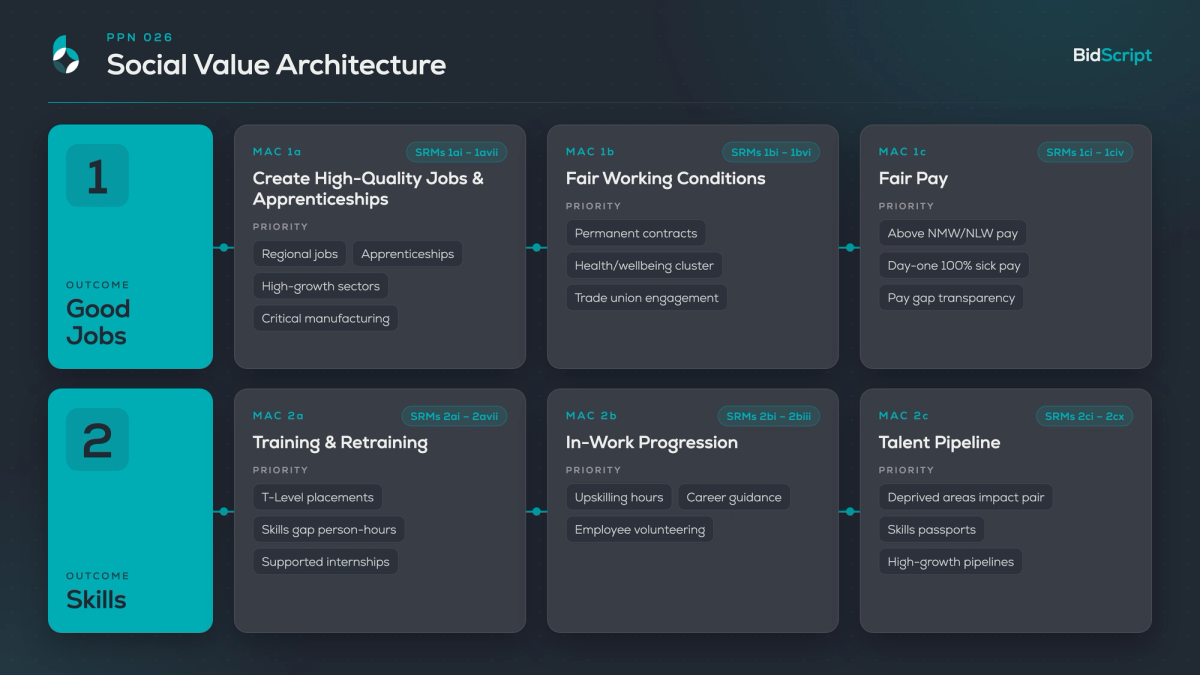
Detailed Focus: Trade Union Engagement under MAC 1b
Reflecting the UK Government's "Plan to Make Work Pay," MAC 1b introduces detailed sub-criteria designed to evaluate workplace representation and employment security. Bid responses addressing MAC 1b must articulate:
- Union Recognition and Access Agreements: Demonstrating transparent union access agreements and providing regular access to relevant workers to encourage meaningful engagement where an independent trade union is recognized.
- Induction Engagement: Explicit protocols ensuring that where a recognized trade union exists, union engagement and information sharing are facilitated directly during the new-starter induction process.
- Workforce Consultation Policies: Establishing formal mechanisms to consult with recognized trade unions on key contract workplace matters, working conditions, and safety protocols.
Structural Metric Evolution: PPN 002 vs. PPN 026 Metrics
- What Is Out: All spend-based metrics have been removed (direct spend with SMEs/VCSEs is replaced by direct headcounts of SMEs and VCSEs in the supply chain). Environmental/net-zero metrics, modern slavery criteria, and standalone crime reduction/domestic violence awareness metrics have been removed from the Social Value Model.
- What Remains: Regional counts of new jobs and Level 2–4+ apprenticeships, permanent employment contracts, pay exceeding National Minimum/Living Wage thresholds, and person-hours of upskilling and career guidance.
- What Is New:
- A dedicated Health and Wellbeing Cluster under MAC 1b (tracking long-term condition support, workplace adjustments, retention rates, and wellbeing participation).
- Hosted or retained T-Level industry placements (MAC 2a).
- Explicit headcounts for critical manufacturing and Industrial Strategy high-growth sectors (MAC 1a, 2a, 2c).
- Learner-owned skills passports (MAC 2c).
- The Deprived Areas Impact Pair (MAC 2c): Metric
2cvcounts the number of people in deprived areas receiving skills training, while metric2cvicounts the number of people reporting a positive impact from that training. Metric2cviis historic: it represents the first standard reporting metric in UK social value history to measure qualitative outcome perception rather than simple numerical output.
7. The 8 Target Cohorts Defined
PPN 026 establishes eight official target cohorts. Bid teams drafting social value responses must tailor their participant journeys, risk mitigations, and support structures specifically around these groups:
- NEETs (16–24 years old): Young people aged 16 to 24 not in employment, education, or training (not enrolled on courses, doing apprenticeships, or working towards qualifications).
- People Transitioning from Education to Employment: Individuals who have left formal education or training within the preceding 12 months.
- People with Long-term Health Conditions or Disabilities: Individuals meeting the disability definition under the Equality Act 2010 facing workplace entry or retention barriers.
- People with Special Educational Needs and Disabilities (SEND) / Neurodiversity: Children or young people requiring special educational provision due to learning difficulties or neurodivergent conditions.
- Care Leavers (aged 16–24): Young adults aged 16 to 24 who were looked-after children for at least 13 weeks (consecutive or non-consecutive) between age 14 and their 16th birthday.
- People on Probation: Individuals serving community sentences, prison leavers, and serving prisoners where support is structured to reduce reoffending.
- Victims of Domestic Abuse: Individuals supported into secure, good employment and protected through specialized workplace safeguarding and special leave provisions.
- Veterans: Former members of the UK Armed Forces transitioning to or securing civilian employment.
STRATEGY CONSULTANT NOTE: ETHICAL DATA PRIVACY & GDPR GOVERNANCE To track and report commitments against the 8 target cohorts (and satisfy quarterly SRM returns), contractors must capture sensitive personal data (e.g., criminal conviction histories, care backgrounds, or disability status). Bidders must establish robust, voluntary ethical self-declaration mechanisms at onboarding, backed by strict GDPR-compliant data segregation. Bids should explicitly describe this privacy framework to prove to evaluators that cohort tracking will be conducted legally, ethically, and without creating workplace stigma.
8. Governance and Post-Award Delivery: Published KPIs and Exclusion Risks
Under PPN 026, contract award is merely the beginning of compliance monitoring; winning bid commitments transition directly into legally binding contractual obligations backed by statutory enforcement mechanisms under PA23.
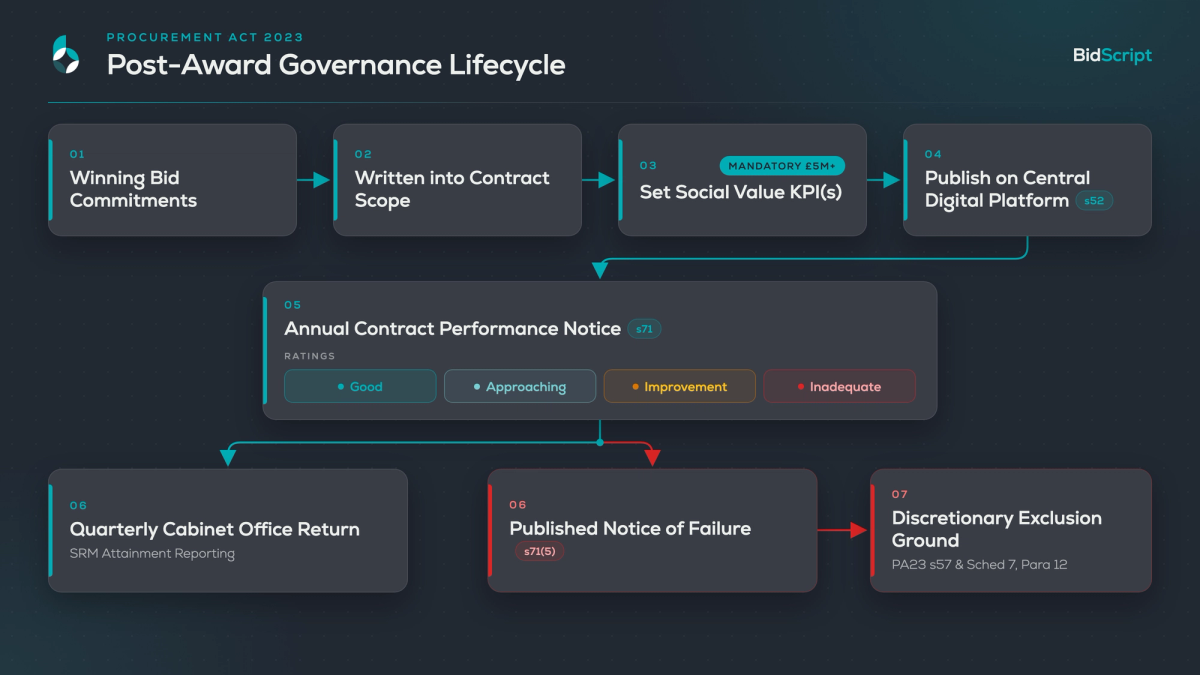
Contract Management & KPI Publishing Requirements
- Contracts £5m or More: Contracting authorities must establish at least one dedicated Social Value KPI published on the Central Digital Platform (in addition to the three standard performance KPIs required under Section 52 of PA23).
- Annual Performance Notices: Performance against social value KPIs must be formally evaluated and published on the Central Digital Platform at least once every 12 months via a Contract Performance Notice using the standardized rating scale: Good, Approaching target, Requires improvement, Inadequate, or Other.
- Quarterly Departmental Returns: Central government departments must submit quarterly numeric and KPI attainment returns to the Cabinet Office tracking delivery against the 37 SRMs.
Severe Legal Exclusion Risk under PA23
The Procurement Act 2023 introduces unmatched commercial consequences for non-delivery. Under Sections 26, 27, 57, and 71 (Schedule 7, Paragraph 12), if a supplier receives a published Contract Performance Notice stating that performance against a social value KPI has been unsatisfactory—and the supplier failed to rectify it after being given an opportunity—contracting authorities possess discretionary statutory grounds to exclude that supplier from future public procurements across the entire UK public sector.
9. Actionable Strategy: 5 Golden Rules for Bid Teams
1. Shift Strategy from Volume to Methodology
Cease leading bid responses with inflated headline numbers. Panel evaluators award top marks to the quality, detail, feasibility, and credibility of the method statement. Structure proposals around structured participant journeys, dedicated mentoring, workplace adjustments, risk mitigations, and clear progression routes.
2. Integrate Delivery and HR Early
Because bid commitments become legally binding contract KPIs backed by statutory exclusion risks, proposal writers must not draft social value answers in isolation. Co-design responses directly with operational leads, HR, and recruitment teams to ensure targets are realistic, resourced, and fully trackable from day one.
3. Audit Data Systems for Target Cohorts and SRMs
Upgrade HR, payroll, and reporting software immediately. Because the 37 SRMs require tracking specific demographics (e.g., care leavers, veterans, neurodivergent staff, and workers in deprived postcodes), ensure internal systems can capture, tag, and report this data ethically via voluntary self-declaration frameworks.
4. Evaluate Community Programmes Strategically
Assess whether backing a scheme from the forthcoming List of Community Programmes offers a lower-risk route to high marks. Submitting an Annex D commitment letter guarantees a baseline score of 6/10 under Annex C, providing a safe scoring foundation. However, keep active track of Cabinet Office announcements, as the official list is currently pending publication.
5. Respect Non-Discrimination and Equal Treatment (Section 90 PA23 Mechanics)
Ensure all social value proposals strictly comply with international treaty-state obligations under Section 90 of PA23. Bids must not mandate local UK supply chain spend, require sub-contractors to be UK-based, or propose local delivery mechanisms that create unlawful obstacles or disproportionate costs for overseas suppliers.
The BidScript Team
The whole team!