How AI Bid Writing Software Works (And What to Watch Out For)
Buyers can now ask how you used AI in your tender. How AI bid writing tools actually work, where they help, and the risks to plan for.
AI bid writing software has moved from experiment to everyday tool for many bid teams. Around 35% of UK businesses with 10 or more employees now use at least one AI technology, up from around 12% in late 2023, according to the Office for National Statistics. Buyers have noticed. Central government guidance now allows contracting authorities to ask suppliers to disclose how they used AI to create their tender.
That changes the question. It is no longer whether to use AI in your bids, but how to use it in a way you would be happy to explain to a buyer, and that still produces answers that score.
This guide explains what AI bid writing software is, how it works step by step, where it helps most, the risks to watch out for, and what to look for when you choose a tool for your team.
What Is AI Bid Writing Software?
AI bid writing software uses generative AI to help bid teams read tender documents, find relevant content and draft responses. The best tools do more than write. They connect to your own past bids, case studies and policies, so the drafts they produce are built from evidence your organisation actually holds.
Think of it as an AI bid writer that works alongside your team, not instead of it. It takes on the slow, repetitive parts of a bid, so your writers can spend their time on strategy, tailoring and the answers that carry the most marks.
How it differs from a general-purpose chatbot
General-purpose AI tools can write fluent text on almost any subject. What they cannot do on their own is know your evidence: your project outcomes, your accreditations, your people and your method. Ask one for a method statement and it will give you a plausible-sounding answer that could belong to any supplier.
Purpose-built AI for bids grounds its output in your own content and in the tender in front of you. Our article on using ChatGPT and Claude for RFP responses looks at where general tools help and where they fall short.
How AI Bid Writing Software Works, Step by Step
Most tools follow the same basic workflow, even if the features are named differently from one product to the next.
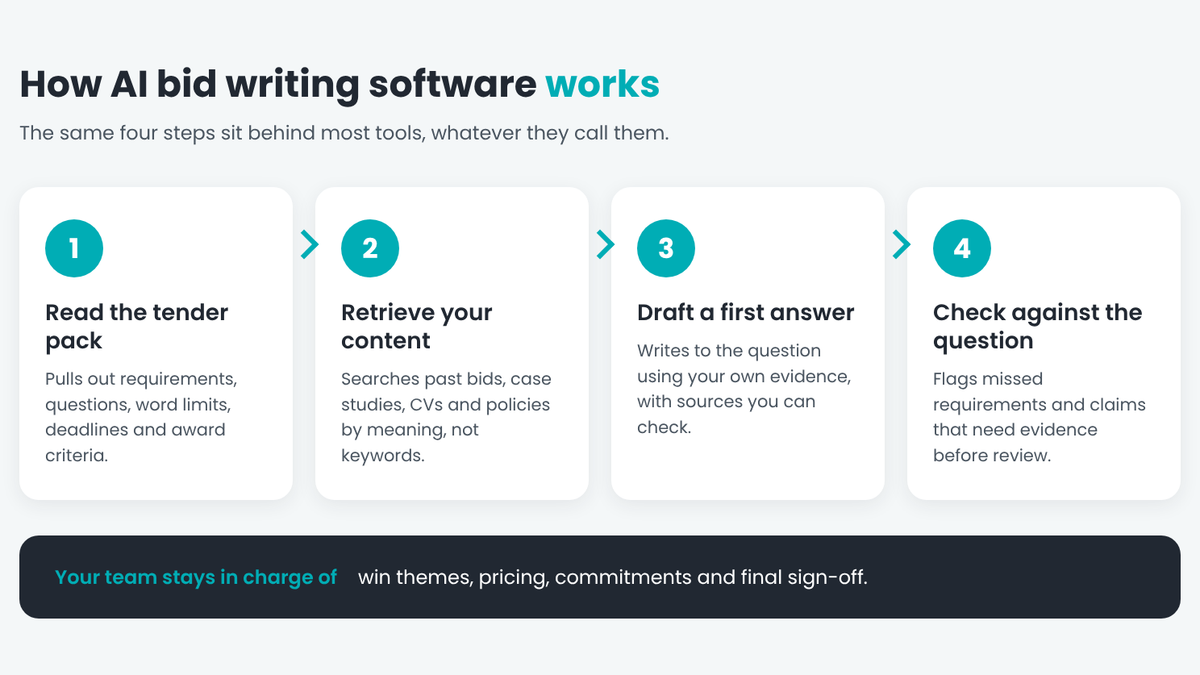
1. It reads and breaks down the tender pack
The tool ingests the tender documents and pulls out the requirements, questions, word limits, deadlines and award criteria. A pack that would take a person hours to read end to end can be summarised quickly, so the team can make an informed bid/no-bid decision early. That matters when the minimum tendering period for a standard electronic tender under section 54 of the Procurement Act 2023 is 25 days.
2. It retrieves your own content
Next, the software searches your knowledge base for relevant material: past answers, case studies, CVs, policies and certificates. Good tools break long documents into smaller passages and search by meaning rather than exact keywords, so a question about "contract mobilisation" still finds your answer headed "implementation plan".
This step is what separates a useful draft from a generic one. If your content is scattered across shared drives, a tool that connects to where it already lives saves a migration project. BidScript's bid library syncs with SharePoint, OneDrive, Google Drive, HubSpot, Salesforce, Teams, Slack and local drives.
3. It generates a first draft
With the question and the retrieved evidence in hand, the AI writes a first draft. A well-designed tool produces a generative AI bid response that is structured to the question and built from your sources, so a writer can check where each claim came from. Our guide to AI bid drafting from your own data covers this step in more detail.
4. It checks the draft against the question
The final step is review. Some tools can compare a draft with the question and the scoring criteria, flag requirements the answer has missed, and point out claims that need evidence. It is a fast first pass before your human reviewers apply their judgement.
Where AI Helps Most in a Bid
AI saves the most time on work that is necessary but repetitive. BidScript's own figures show around 2x productivity per bid team member. The biggest gains usually come from:
- Summarising tender packs and building a list of every requirement
- Finding the right evidence in seconds instead of searching folders and inboxes
- Producing first drafts of standard questions on quality, health and safety, and social value
- Tracking changes when clarifications and amendments arrive mid-tender
- Checking compliance with word limits, formats and mandatory requirements
- Self-scoring drafts against the evaluation criteria before submission
Where AI helps least is the work that wins: choosing win themes, understanding what this particular buyer cares about, pricing, and making commitments your organisation can deliver. Those decisions need people who know the business. Our guide to speeding up RFP responses shows how AI fits into a faster process without cutting corners.
If you want to see how this looks inside a single platform, BidScript's AI bid writing software, BidBot, analyses tenders, researches the web with sources, tracks amendments, drafts inside BidScript and stress-tests answers in Evaluator Mode. It is rated 4.8 on G2.
What to Watch Out For With AI Bid Writing Software
AI can make a good bid team faster. Used carelessly, it can also put errors and risk into a submission at speed. These are the issues to plan for.
Invented claims
Generative AI can produce statements that sound right but are not supported by any evidence, such as a project that never happened or a figure no one can source. In a tender, an unsupported claim can cost marks, and a false one can cause far bigger problems once the contract is awarded.
The safeguard is traceability. Every claim in an AI-assisted answer should link back to a real source that a reviewer can check. Our article on why inspectable AI matters in bidding explains why this matters.
A practical habit helps here. When a reviewer reads an AI-assisted answer, they should be able to point to the case study, policy or past bid behind every number, name and commitment in it. Anything they cannot trace either gets a source or comes out. It sounds slow, but it is far quicker than discovering after award that your team promised something the business has never delivered.
Confidential information

Tender documents and your own bid content often include commercially sensitive information. Before using any AI tool, check where your data is processed and stored, whether it is used to train models, and who can access it. Buyers care about this too. Central government guidance specifically raises the risk of suppliers putting the contracting authority's confidential information into AI tools.
Buyer rules on AI use
PPN 017 applies to central government departments, their executive agencies and non-departmental public bodies, and replaces PPN 02/24 for procurements starting on or after 24 February 2025. It does not ban suppliers from using AI. It does allow buyers to ask suppliers to disclose their use of AI in the creation of their tender, and to put proportionate controls in place.
In practice, that means reading each tender pack for AI questions or instructions, and keeping a clear record of how AI was used on each bid so your answer is quick and honest.
Generic answers that score poorly
An AI draft is only as specific as the content behind it. If your library is thin or out of date, the output will be bland, and bland answers rarely reach the top band of a scoring matrix. Evaluators reading dozens of tenders can spot a generic answer quickly.
Treat every AI draft as a starting point. Tailor it to the buyer's priorities, add evidence and check it against the evaluation criteria before it goes anywhere near a submission.
How to Introduce AI Into Your Bid Process
Buying a tool is the easy part. Getting real value from it depends on how you roll it out. The ONS found that a lack of expertise is one of the most cited barriers to AI adoption, and around 62% of businesses citing it are training or retraining existing staff. Teams that see the best results tend to treat adoption as a change to their process, not just a new login.
Get your content in order first
AI drafts are only as good as the library behind them. Before you switch anything on, retire out-of-date answers, check that certificates and policies are current, and make sure your best case studies are easy to find. An hour spent cleaning your content saves many hours of correcting weak drafts later.
Start with one type of bid
Pick a bid type you respond to often, such as a recurring framework call-off or a standard quality questionnaire, and pilot the tool there. Compare hours spent and scores achieved against similar bids written the old way. A focused pilot gives you evidence to build on, and shows the team where the tool helps and where it does not.
Set clear rules for review
Agree who checks AI drafts, what they check for and who signs off. A simple rule works well: no AI-assisted claim goes into a submission until a named person has checked it against its source. Write the rule down and include it in your bid kick-off.
Keep a record of AI use
For each bid, note which answers were drafted with AI support and how they were reviewed. It takes minutes, and it means that if a buyer asks how you used AI, your team can answer accurately and quickly.
Measure what changes
Track hours per bid, time to first draft and your win rate on qualified opportunities. If hours fall and quality holds, the tool is working. If scores slip, look at the content and review steps before blaming the software. BidScript reports an average payback period of just over 4.1 months.
How to Choose AI Bid Management Software
Most tools now offer some form of AI writing, so the differences lie in how well it works for bids. When you compare AI bid management software or any AI proposal writing tool, ask:
- Is it grounded in your content? Drafts should be built from your own library, with sources you can check.
- Does it connect to where your content already lives? Avoid tools that require a long migration before you can start.
- Can it read a full tender pack? Look for requirement extraction, summaries and amendment tracking.
- Does it help you qualify? Bid/no-bid support stops you wasting AI-saved hours on bids you will not win.
- How does it handle security? Ask about data storage, model training, access controls and certification.
- Does it support review, not just drafting? Checking answers against the scoring criteria is where AI adds quality, not just speed.
- Is it built for UK public sector bidding? Procurement Act 2023 terminology, conditions of participation and social value questions should feel familiar to the tool.
For a wider view of the market, see our independent guide to the best bid management software and our 2026 playbook for AI in tender management.
AI Bid Writing Software: FAQs
What is AI bid writing software?
AI bid writing software uses generative AI to help bid teams respond to tenders. It reads tender documents, finds relevant content in your knowledge base and produces structured first drafts. The best tools ground every draft in your own evidence, so reviewers can check sources, and support the whole bid process rather than writing in isolation.
Can AI write a whole tender response?
AI can produce useful first drafts of most questions, but it should not write a final submission unsupervised. It cannot judge what a particular buyer values, set your price or decide which commitments your organisation can deliver. The strongest results come from AI drafting grounded in your own content, followed by human tailoring and review.
Do I have to tell buyers I used AI in my bid?
It depends on the buyer. Under PPN 017, central government buyers can ask suppliers to disclose their use of AI in creating a tender. If a tender asks, answer accurately. If it does not, check the instructions for any rules on AI use. Keeping a record of how AI was used on each bid makes any question quick and easy to answer.
Is AI bid writing software secure?
It varies by provider. Before adopting a tool, check where your data is stored and processed, whether it is used to train AI models, how access is controlled and what security certifications the provider holds. Tender content is often commercially sensitive, so treat security as a selection criterion, not an afterthought.
Will AI-written bids score lower?
Not if they are done well. Evaluators score the content against the award criteria, not the tool that helped write it. Generic answers score poorly whoever writes them. AI drafts built from specific, evidenced content and then tailored by your team can score as well as, or better than, answers written from scratch.
Final Thoughts
AI bid writing software works best as a fast, well-informed assistant: it reads the pack, finds your evidence, drafts a first answer and checks it against the question. It works worst as an unsupervised writer with no access to your content.
Choose a tool that grounds every draft in your own sources, keeps your data secure and supports review as well as writing. Keep people in charge of strategy, pricing and sign-off, and be ready to explain your use of AI if a buyer asks.
BidScript is an AI-native bid management platform built for in-house work-winning teams. Early customers have seen win rates improve by up to 50%. Book a demo to see how AI can support your team from tender pack to submission.
The BidScript Team
The whole team!
Read Next
AI Bid Drafting: Evidence-Backed Tender Responses From Your Data
Bid teams face increasing pressure to respond to more tenders, faster, without compromising quality or compliance. Our AI-powered Bid Drafting System solves this by generating structured, evidence-backed first drafts using your organisation’s own data — helping teams move faster with confidence.

Stop Trusting Answers: Why Inspectable AI Is the Future of Bidding
In complex tender environments, plausibility is not the standard. Defensibility is. If a claim cannot be traced to a precise source location, it is confidence - not control.
ChatGPT (and Claude) for RFP Responses: Where it can & can't help
On the surface, it feels like a silver bullet: instant drafts, fast automation, content on demand for just $20 a month, but does it truly deliver value?